
 Clear scope. Clean execution.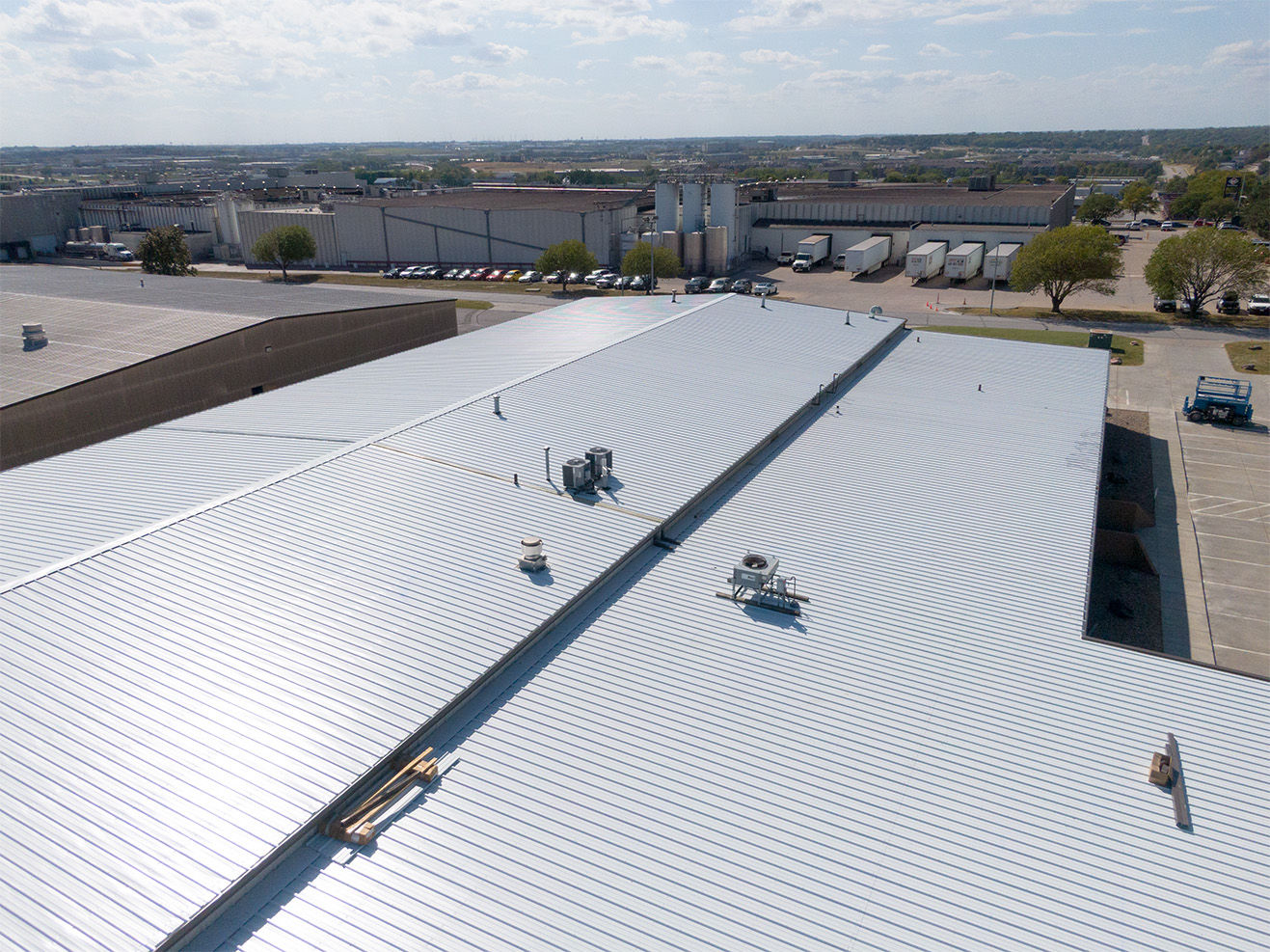
Standing seam metal roofing is the premium-service-life system in the commercial market. Concealed-fastener panels with mechanically seamed or snap-lock standing seams eliminate the exposed fastener penetrations that limit the service life of screw-down metal systems. A properly installed standing seam system with a factory Kynar 500 finish on Galvalume steel or painted aluminum carries 40 to 50 years of service with minimal maintenance - longer than any single-ply system in the market.
Commercial Roofers of San Antonio installs standing seam metal systems on the building types where the service life and architectural premium are justified. San Antonio has a specific concentration of these projects: the Pearl District mixed-use buildings along the Museum Reach of the Riverwalk, which use standing seam metal to reference the historic brewery's industrial vernacular; schools in the Northside Independent School District and San Antonio ISD that need roofs lasting the life of the building; and religious facilities across the metro - from established Catholic churches in the historic neighborhoods to large nondenominational campuses on Loop 1604 - that have architectural rooflines incompatible with flat-roof single-ply systems.
System Types - Snap-Lock, Mechanically Seamed, and Structural
Snap-lock panels use a factory-formed female leg that snaps over the adjacent panel's male leg. Installation is fast and does not require a seaming machine. Snap-lock systems are the standard specification for architectural applications with pitches above 3:12 - they handle the expansion and contraction of the panel across San Antonio's thermal cycling and provide a clean standing seam profile. They are the most common system on school and religious facility projects in the metro.
Mechanically seamed panels require a mechanical seamer tool that runs along the seam after installation, folding the panel legs into a 360-degree lock. The resulting seam is tighter than snap-lock and provides better wind-uplift resistance for low-slope or near-flat applications. Mechanically seamed systems are required on pitches below 3:12 - a condition common on the commercial buildings in the Pearl District and on institutional buildings where the roofline geometry includes both sloped and near-flat sections.
Structural standing seam systems span from structural support to structural support without continuous substrate - used on agricultural, industrial, and some commercial applications where the building does not have sheathing. For most San Antonio commercial and institutional projects, the substrate is plywood or a steel deck with insulation, and the choice is between snap-lock and mechanical seam based on pitch and wind exposure.
Material Selection - Galvalume Steel, Aluminum, and Coatings
Galvalume steel is the volume commercial specification. The zinc-aluminum coating on Galvalume provides corrosion resistance that outlasts galvanized steel significantly, and the Galvalume surface under a Kynar 500 or Hylar 5000 PVDF coating produces a finish that retains color and gloss for 30-plus years in San Antonio's UV environment. This is the standard specification for school and institutional projects in the metro.
Aluminum is used when corrosion resistance is a primary concern - buildings near chemical processes, high-humidity environments, or coastal conditions where salt spray is a factor. San Antonio is not a coastal environment, but aluminum sees use on medical and laboratory facilities where chemical exposure from HVAC exhaust is a concern. Aluminum is softer than steel and more susceptible to denting under hail, which is a relevant factor in San Antonio's hail-risk environment.
Paint system: Kynar 500 PVDF two-coat or three-coat systems are the standard for San Antonio commercial work. The Kynar finish provides the chalk and fade resistance that justifies the service life claim - a lesser paint system will begin showing color degradation within 10 years in San Antonio's UV environment. Most manufacturer warranty programs require Kynar 500 or equivalent PVDF as a condition of the finish warranty.
Standing Seam Metal on San Antonio's Schools and Religious Facilities
Northside ISD, San Antonio ISD, Northeast ISD, and Alamo Heights ISD all have building inventory that carries standing seam metal roofing - older buildings with the original metal systems installed during construction, some now approaching 40 years of age and beginning to need panel replacement, sealant replacement at penetrations, and paint restoration rather than full roof replacement. We inspect and maintain these systems as well as install new ones.
Religious facilities represent a large and varied market in San Antonio. The established Catholic parishes near downtown - San Fernando Cathedral on Main Plaza, the mission churches on the Mission Road corridor - have historic slate and clay tile rooflines that require specialized restoration rather than standing seam. The growing large-format church campuses on Loop 1604 Northwest and Stone Oak - where the architectural program requires visible rooflines over large multi-use sanctuaries - are the standing seam metal market. These buildings have roof areas of 20,000 to 100,000 sq ft and architectural requirements that exclude single-ply flat roofing from most areas.
Pearl District and architectural commercial: The Pearl redevelopment has been the most architecturally specific commercial roofing environment in San Antonio over the past decade. Standing seam metal references the historic tin rooflines of the original brewery complex and is required on several of the new buildings in the development. The finish specifications from the Pearl's design standards are precise - color, seam spacing, panel width - and we coordinate directly with the project architect on specifications.
Frequently asked questions
How does standing seam metal handle San Antonio hail events?
Steel standing seam at 24 gauge handles most San Antonio hail events without damage - the Hill Country storm cells that produce hail in this market typically deliver stones in the 1-to-2-inch range, which steel panels at appropriate gauge resist without visible denting. Aluminum panels are more vulnerable and more likely to show cosmetic hail denting. We document the gauge and material specification at closeout so the building owner has the relevant information for insurance purposes.
Can standing seam metal be installed over an existing flat roof?
Yes. Installing a standing seam metal system over an existing flat roof is a common recover strategy on San Antonio buildings that need a roof upgrade and want to eliminate the flat-roof maintenance cycle permanently. The framing system to create pitch above the existing flat surface is part of the scope. This approach also eliminates the tear-off cost on the existing system and creates a vented cavity that can reduce the thermal load on the building. We scope over-roof standing seam systems on buildings where the structural load capacity supports the additional framing weight.
What is the service life of a standing seam metal roof in San Antonio?
40 to 50 years on a Galvalume steel system with a Kynar 500 finish installed to manufacturer specification. The primary maintenance items are sealant replacement at penetrations and pitch pans every 10 to 15 years, snow guard and cleat inspection, and paint system condition monitoring. The panel seams themselves require no maintenance if properly installed. This service life makes standing seam the lowest-lifecycle-cost roofing system for buildings where the architectural program is compatible.
Specifying standing seam metal for a San Antonio building?
Our project managers will assess the structural load, review the architectural program, and produce a standing seam scope with material specification, panel profile, and 40-year lifecycle cost estimate.
Request a Roof Scope