
 Clear scope. Clean execution.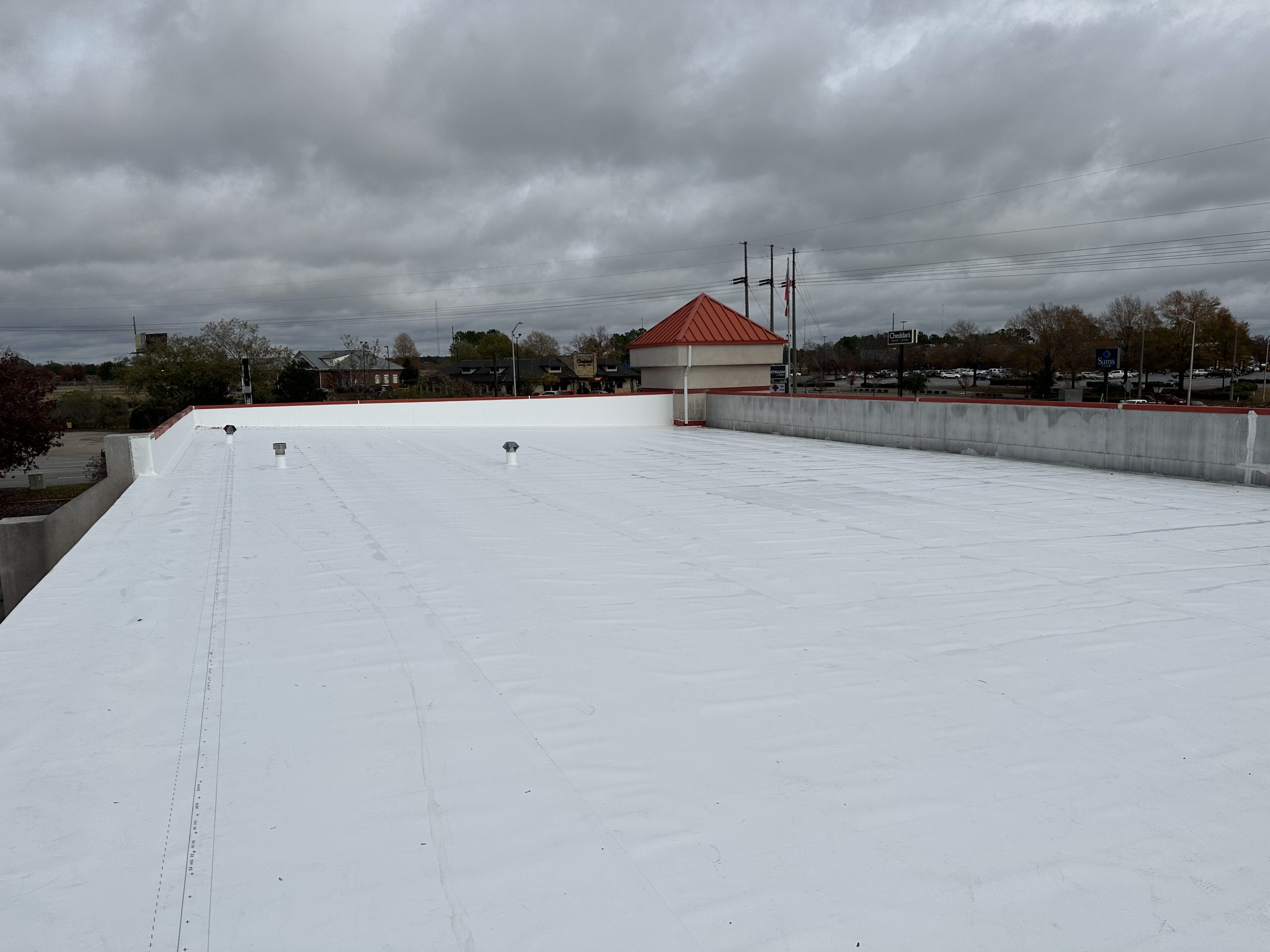
The Pearl District north of downtown is one of the densest concentrations of restaurants and food-service operations in San Antonio - the Pearl Brewery redevelopment, Hotel Emma, the weekend farmers market, and the surrounding bar and restaurant corridor along Broadway and the Museum Reach of the Riverwalk. The Southtown and King William neighborhoods carry a similar density of independent restaurants, food halls, and small commercial kitchens. Every one of those operations vents grease-laden exhaust through a rooftop exhaust stack, and grease is one of the most destructive materials a commercial roof membrane encounters.
TPO and EPDM are not grease-resistant. Grease penetrates the plasticizers in these membranes over time, causing accelerated oxidation and cracking around exhaust stack flashings. PVC - polyvinyl chloride - is the chemically resistant alternative. PVC membranes are inherently resistant to grease, fats, cooking oils, and many cleaning chemicals. Restaurant and food-service buildings across San Antonio's active dining districts have been running PVC under their exhaust stacks for decades, and the chemical resistance holds up. Commercial Roofers of San Antonio installs PVC systems on new restaurant construction, on recover-over-existing projects, and on partial-replacement zones around exhaust stacks on mixed-membrane roofs where TPO or EPDM covers the main field but PVC is needed at the chemical-exposure zones.
50-mil vs. 60-mil PVC
50-mil PVC is the baseline specification for light-duty restaurant and food-service roofs with limited rooftop mechanical traffic. It carries warranty paths from Sika Sarnafil, Carlisle, and other major PVC manufacturers and is adequate for most Pearl District and Southtown restaurant buildings where the primary exposure concern is grease exhaust at the stack flashings and cleaning chemical runoff.
60-mil PVC is the specification when rooftop mechanical equipment requires frequent maintenance access, when the building hosts multiple heavy exhaust units from a large commercial kitchen operation, or when the owner wants the extended warranty - some manufacturers offer 25-year NDL warranties on 60-mil PVC that are not available on 50-mil. For the larger food-hall and multi-tenant restaurant buildings on the Pearl campus and along the East Side entertainment corridor, 60-mil is the right specification.
PVC welds with hot-air seaming tools, the same way TPO does, which gives PVC seams the same full-fusion bond advantage over EPDM's adhesive lap seams. The welded seam is PVC's primary structural advantage - it does not rely on adhesive chemistry that can be compromised by the cleaning chemicals present in food-service environments.
Why Chemical Exposure Matters for Roof Membrane Selection
Grease and fats from restaurant exhaust condense on the roof surface and migrate toward seams and flashings. On TPO or EPDM, this contamination penetrates the membrane at the molecular level over one to three years and causes plasticizer extraction that leads to cracking and brittleness. The failure mode looks like sun damage but originates with the chemical exposure. Once it starts, the only fix is membrane replacement - patching does not restore a chemically degraded membrane.
Cleaning chemicals are a secondary exposure concern on food-service roofs. Roof cleaners containing petroleum distillates or certain solvents can damage TPO and EPDM membranes on contact. PVC's inherent chemical resistance handles the typical cleaning agents and degreaser runoff that food-service buildings generate.
Mechanical penetrations around exhaust stacks are the highest-risk zone on any restaurant roof. We use manufacturer-certified PVC pipe boots and pitch pans at every exhaust penetration, seal them with compatible sealant, and photograph every detail at closeout. The exhaust stack zone is where the chemical exposure is most concentrated, and the flashing detail at those penetrations is where PVC's chemical resistance matters most.
PVC on San Antonio's Restaurant Districts
The Pearl District redevelopment runs approximately 25 food and beverage operations on the main campus. Multiple rooftop exhaust stacks per building, high rooftop mechanical equipment density from the hotel HVAC plant, and aesthetic requirements from the Pearl's architectural standards make this a PVC environment - not a TPO environment. We have worked on buildings in the Pearl campus and understand the access coordination and aesthetic requirements.
The Southtown and King William districts carry older building stock - many of the restaurant buildings are 1920s through 1950s masonry with flat or low-slope rooflines. The roofs on these buildings often have multiple generations of repair patches and incompatible materials. Full-replacement PVC systems on these buildings require careful substrate prep because the existing surface is rarely uniform enough for adhered installation without a cover board.
East Side and South Flores corridor: The entertainment and restaurant corridor along South Flores and the East Side near Cattleman Square adds a third concentration of food-service roofing in San Antonio. Buildings in this zone are a mix of commercial new construction and repurposed industrial buildings. PVC is increasingly the specified system on new restaurant build-outs in both zones.
Frequently asked questions
Do all restaurant roofs need PVC?
Not necessarily. If the restaurant has limited exhaust - a small café or bar with minimal cooking - and the roof is separated from the exhaust stacks by significant distance, TPO with PVC-flashed exhaust penetrations may be adequate. The full-PVC recommendation applies when the rooftop has multiple heavy exhaust units, when cleaning chemical runoff regularly contacts the membrane, or when prior TPO or EPDM on the building has already shown chemical degradation. We assess the exhaust load and the prior damage pattern during inspection and give a direct recommendation.
Can PVC go over an existing TPO or EPDM roof?
Yes, with the right substrate prep. PVC can be installed as a recover over most single-ply membranes when the existing insulation is dry and the existing membrane is clean and adhered. The one caveat is that PVC plasticizers can migrate into the substrate from contact with certain TPO formulations - a separator sheet is required in some recover assemblies. We verify the compatibility before specifying the recover stack.
What does a 25-year PVC warranty cover?
The 25-year NDL warranty from manufacturers like Sika Sarnafil covers manufacturing defects in the membrane and installation defects found during the manufacturer's warranty inspection, for both labor and materials, over the 25-year term. It requires documented annual maintenance. The warranty is registered by the installing contractor at closeout - we handle the registration and build the first annual maintenance inspection into the project closeout package so the warranty does not start running without a maintenance record.
Specifying a PVC system for a San Antonio restaurant or food-service building?
Our project managers will assess the exhaust load, inspect the existing membrane for chemical degradation, and produce a PVC scope with 25-year warranty path and installed-cost estimate.
Request a Roof Scope