
 Clear scope. Clean execution.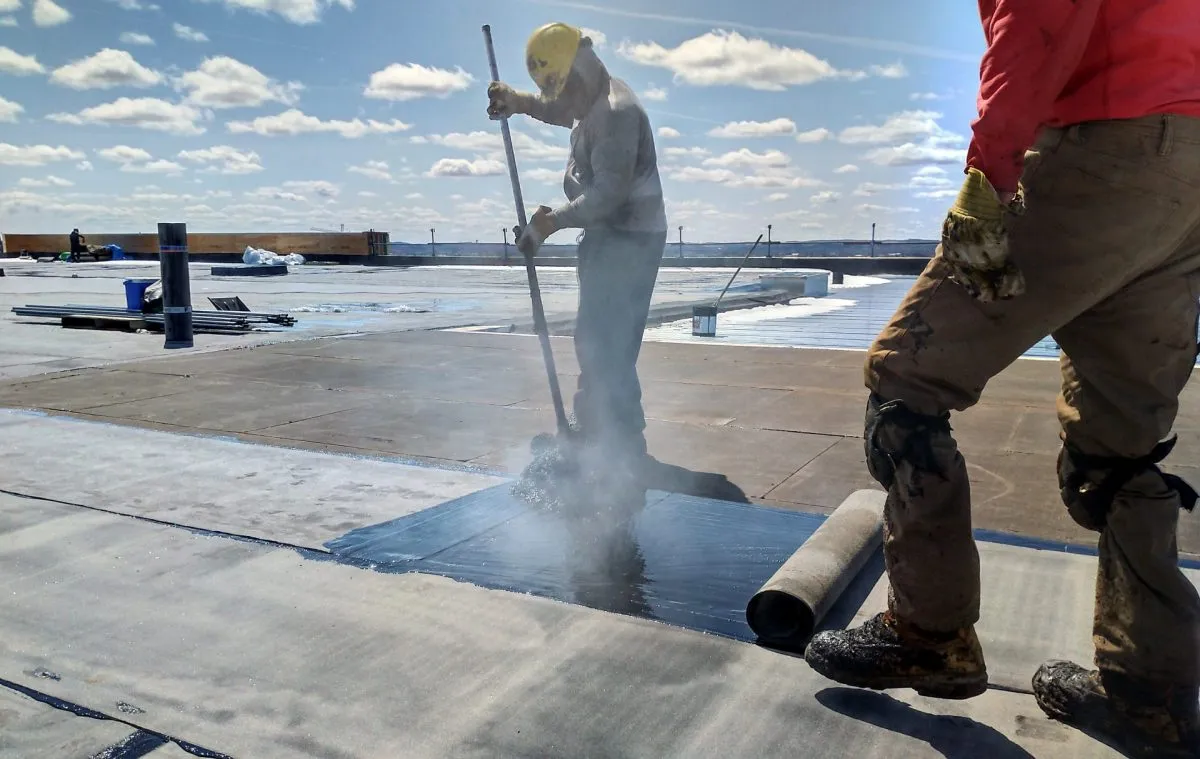
Built-up roofing - alternating layers of roofing felt and hot-applied asphalt or coal tar, finished with aggregate surfacing - was the commercial roofing standard for most of the 20th century. San Antonio's downtown commercial buildings, the older institutional buildings around the established university campuses, and the mid-century office and industrial facilities that predate the current suburban corridors are still running BUR systems in various stages of deterioration.
The honest assessment of most of these systems is that they have exceeded their design life. A coal-tar BUR installed in 1970 on a downtown San Antonio building was designed for 20 to 25 years of service. It has been repaired, patched, and perhaps had a mod-bit cap sheet applied over it, and it is now pushing 50 years old. The insulation beneath it has absorbed decades of the Texas heat cycle. The felts are oxidized and brittle. Commercial Roofers of San Antonio does not try to extend these systems beyond their useful life with more patches - we assess them honestly, pull moisture cores, and produce a capital-replacement plan that the building owner can take to their budget cycle.
Coal-Tar BUR vs. Asphalt BUR - What We Find in San Antonio
Coal-tar BUR and asphalt BUR are both multi-ply systems, but the performance over time differs significantly. Coal-tar pitch is a self-healing material - minor surface cracks close under solar heating. Buildings with original coal-tar BUR in San Antonio's downtown sometimes have surface conditions that look better than their age suggests, because the coal-tar has flowed and re-sealed surface cracking over decades. The hidden failure is in the felts and insulation beneath the surface, not on it.
Asphalt BUR oxidizes differently. Asphalt becomes brittle with age and UV exposure, and the felt layers below the asphalt surface begin to delaminate as the asphalt loses its adhesive quality. San Antonio's sustained summer heat accelerates this process. Asphalt BUR from the 1970s and 1980s on San Antonio buildings regularly shows inter-ply delamination visible as blistering, ridging, and buckled sections - the signs that the system has failed structurally and is no longer providing a continuous waterproofing membrane.
The distinction matters for replacement planning. Coal-tar buildings often have more structural felt integrity remaining, which can support a recover if the insulation is dry. Asphalt BUR buildings with delaminated felt layers typically cannot support a recover - the new system needs a solid substrate, and delaminated asphalt felt is not one. We document which system is present and in what condition as part of every BUR inspection.
Moisture Survey and Replacement Planning on Legacy BUR
Moisture cores are the starting point on every BUR project we inspect. We pull cores in a representative grid - typically one core per 2,000 to 5,000 sq ft, more densely in areas with visible damage or known prior leak history. Each core is photographed and labeled to the zone diagram. Wet insulation reads visually and often with a moisture meter confirmation. We document the wet-area percentage, map it against the zone diagram, and produce a written assessment.
If wet insulation is under 25% of the total area, a targeted repair and recover is potentially viable - remove the wet areas, install new insulation and base sheet in those zones, and recover the dry areas with a new membrane. If saturation exceeds 25%, full tear-off is the honest recommendation. Recovering more than a quarter of a roof over wet insulation produces a system that will fail faster than the replacement cost justifies.
Deck condition is the second variable. We pull deck inspection ports below wet cores and at visible deflection points. Corroded metal deck or rotted wood plank deck under a wet BUR system requires deck replacement before any new roofing goes down - which changes the project budget significantly and triggers a different permit category. Owners need that information before they commit to a budget, not when the crew pulls back the first section of roofing and stops work.
What Replaces BUR on San Antonio Legacy Buildings
On downtown San Antonio buildings with structural load constraints, the replacement system is almost always a single-ply - TPO 60-mil or EPDM 60-mil - over new insulation, because the single-ply assembly is lighter than a new BUR system and meets current Texas energy code insulation requirements in a thinner profile. The reflective surface of a white TPO system also eliminates the rooftop heat load that the dark BUR surface was generating.
Modified bitumen is the alternative when the building owner wants a traditional multi-ply system that more closely resembles what is being replaced, or when the project involves a partial replacement that needs to tie into an existing mod-bit system at an expansion joint.
The permit path on replacement of BUR systems on downtown San Antonio buildings typically runs through the City of San Antonio Development Services Department. On buildings in the downtown historic districts or near Alamo Plaza, we coordinate with the Office of Historic Preservation when the scope involves any element with exterior visibility - parapet coping, drainage, rooftop equipment screening.
Frequently asked questions
How do I know if my San Antonio building still has its original BUR?
On buildings from the 1960s through the early 1980s, if the roof has not had a documented single-ply replacement, there is a reasonable probability that the base system is still BUR - either original or with mod-bit recover layers above it. The roofing history is sometimes in the building maintenance records; often it is not. A visual inspection combined with a core sample will show the layer stack and identify whether BUR felts are present.
Can BUR be repaired rather than replaced?
Active BUR with intact felts and dry insulation can be repaired - blistered sections cut open, dried, and re-felted; aggregate replaced; membrane patches applied. For buildings with limited wet areas and a 5-to-10-year budget horizon before the next reroof cycle, a documented repair program can extend the asset and defer the capital. For buildings where the felts are brittle, the insulation is saturated in more than 25% of the area, or the deck has corrosion, repair is not a capital-efficient decision.
What does a BUR replacement cost relative to other systems?
New BUR installation is rare today because it is more expensive and more disruptive than single-ply alternatives. The hot-asphalt kettle operation, felt ply installation, and aggregate application all require specialized crew and equipment that adds to the installed cost. Most BUR replacements in San Antonio go to single-ply - TPO or EPDM - which installs faster, carries modern NDL warranty terms, and meets energy code requirements more efficiently.
Legacy BUR on a San Antonio commercial building?
Our project managers will inspect the system, pull moisture cores, assess the deck condition, and produce a written replacement plan with budget estimate and capital-planning timeline.
Request a Roof Scope