
 Clear scope. Clean execution.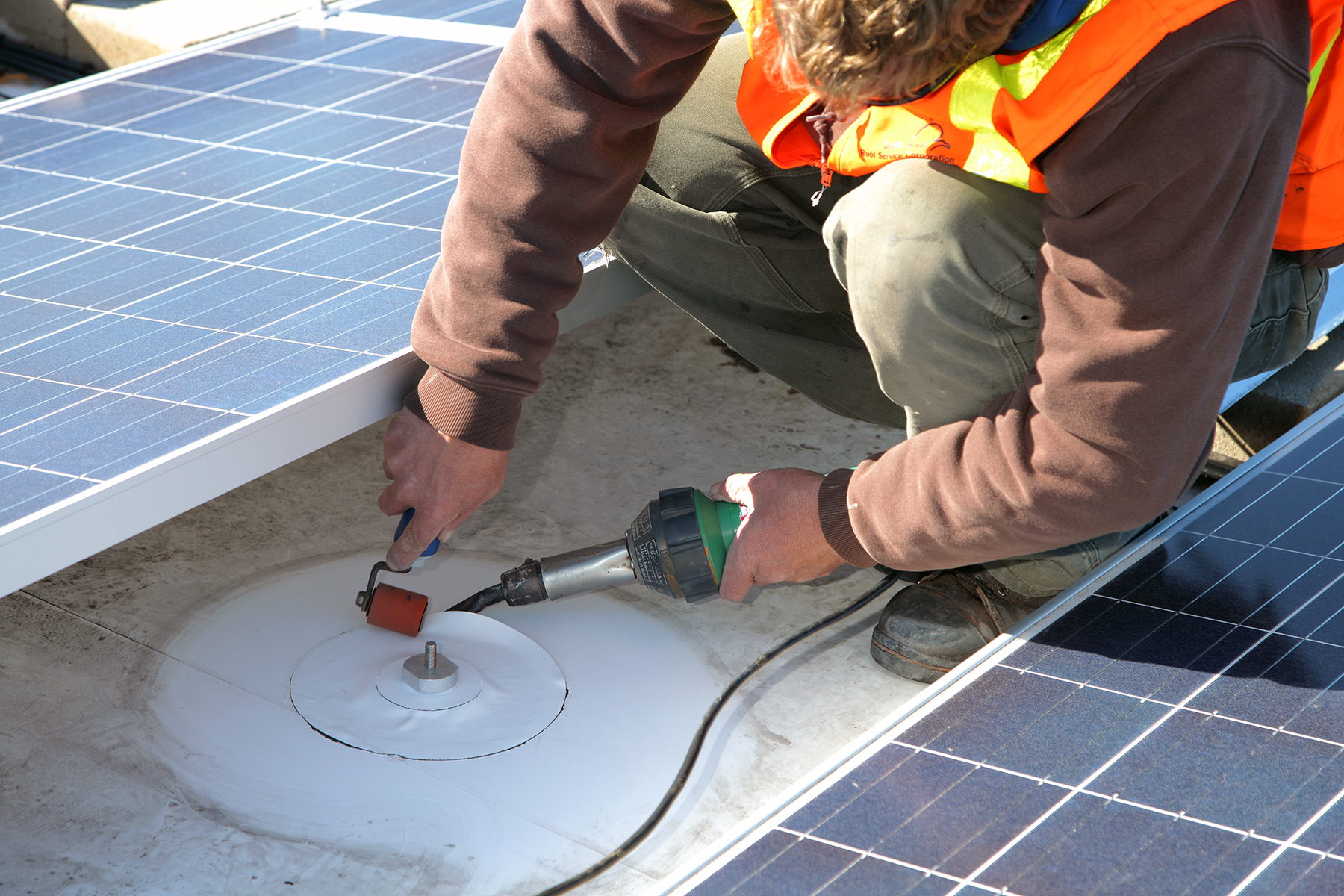
Solar Belongs to the Roof Before It Belongs to the Electrician
San Antonio gets the kind of sun that makes a rooftop array pencil out fast, and CPS Energy's net-metering and rebate history has pushed a lot of commercial owners here to look hard at PV. What we ask them to slow down on is the assumption that solar is an electrical project that happens to sit on a roof. It is the reverse. Every foot of racking, every conduit run, and every junction box lands on a waterproofing system that someone has to keep intact for the next two or three decades. When that part is treated as an afterthought, the array becomes the most expensive way imaginable to ruin a good roof.
We do not sell panels, size inverters, or file your interconnection paperwork. Our lane is the roof: confirming it can carry and resist what is about to be bolted to it, flashing every attachment so it never leaks, and getting the membrane manufacturer to bless the design in writing before the solar crew shows up with a drill. On a project that goes right, the installer and the roofer are talking weeks before mobilization, not meeting for the first time on the roof.
The Service-Life Math That Decides Everything
The first question on any San Antonio solar job has nothing to do with kilowatts. It is how many years are left in the roof under the array. A PV system is commonly warranted past twenty-five years. If the membrane beneath it has eight, the day that membrane fails you are paying a crew to detach hundreds of panels, store them, reroof, and reset the array - a number that on a mid-size building can eclipse the original install.
So we settle the roof first. We assess remaining service life, run an infrared moisture survey to confirm the insulation underneath is dry, and pull a few core cuts to verify the deck. If the roof has roughly twelve or more sound years left, mounting on what is there is reasonable. If it is closer to the back third of its life, we make the case to reroof first, or to fold the solar mounting into a planned replacement so the array sets down on a fresh, warranted membrane.
Ballast or Penetrate: A Roofing Decision, Not Just a Solar One
Low-slope commercial roofs around the city - the big TPO and PVC fields on the distribution buildings near the I-35 corridor and out toward Port San Antonio, the modified-bitumen assemblies on older Southside warehouses, the standing-seam metal on dealerships along Loop 1604 - each take solar differently, and the racking method follows the roof.
- Ballasted racking weighs the array down with concrete blocks or filled trays sitting on slip-resistant protection pads, so the membrane is never pierced. That is appealing until you weigh it, literally. Ballast routinely adds four to six-plus pounds per square foot across the footprint, and many older San Antonio buildings were designed to lighter loads than that. A structural engineer has to sign off before this is even on the table.
- Mechanically attached racking anchors standoffs through the membrane into the structure. It is lighter and grips harder against wind, but it turns every standoff into a penetration we are responsible for flashing and the manufacturer is responsible for warranting.
Uplift drives this choice as much as weight does. San Antonio sits squarely in thunderstorm country, and the gust fronts that roll through in spring and early summer regularly hit 50 to 70 mph. A panel field is a sail, and wind pressure does not load a roof evenly - it spikes hard at the corners and along the perimeter. The ballast has to be zoned heavier in those zones, or a mechanical layout engineered for them. We have seen ballasted arrays designed to a single flat ballast number creep across the membrane in a storm because nobody accounted for the corners - an avoidable, expensive lesson.
Penetrations and Conduit Are Where the Leaks Live
Anywhere steel passes through a membrane is a future leak unless it is detailed correctly. On a mechanically attached array that means a manufacturer-approved flashed base or welded curb at each standoff - heat-welded or sealed into the field sheet - not a hardware-store pipe boot and a bead of mastic. We build those details with our own crew, because no membrane manufacturer will warranty a penetration their certified contractor did not execute to their specification.
Conduit is the part people forget. The DC and AC runs feeding the inverters and dropping into the building's service have to cross the roof. Lay that conduit flat against the membrane and it saws into the sheet every time the metal expands and contracts - and San Antonio rooftops are punishing in summer, with dark-membrane surface temperatures pushing past 160°F on a clear July afternoon. We require the conduit up on bearing-pad supports and every roof drop flashed through the assembly, all of it mapped with the solar EPC in preconstruction before the first hole is cut.
Membrane Compatibility and the Heat Penalty
Not every roof surface wants to live under an array. We steer most San Antonio owners toward a reflective white TPO or PVC: the cooler surface beneath the panels helps the array run more efficiently in this heat, and heat-welded thermoplastic seams shrug off installation and maintenance foot traffic better than older adhered systems. Where a dark or aging membrane is staying put, we look hard at whether the heat trapped under a dense panel field will accelerate its breakdown - sometimes that alone tips a building toward reroofing first. On standing-seam metal, we use clamp-style attachments that grip the seam without piercing it, keeping the waterproofing plane whole.
Two Warranties That Have to Survive Each Other
What protects an owner for the long haul is getting the roofing manufacturer and the solar installer aligned on paper before anyone mobilizes. The major membrane makers will keep a roof warranty in force under a rooftop array - but only if the design clears their review: approved attachment or ballast details, approved walkway protection on the service paths, and a field inspection by their representative after install. We run that review as part of the scope so you never end up holding a valid solar warranty bolted to a voided roof warranty. When a leak shows up two years out, you want one clear party responsible, not a roofer and a solar contractor pointing at each other over your wet inventory.
What We Own on a Solar Roof Project
- Pre-solar roof condition assessment, infrared moisture survey, and a defensible remaining-service-life estimate so you know whether to reroof first.
- Structural load coordination for ballasted systems, including corner and perimeter ballast zoning for wind uplift.
- Installation and flashing of every racking penetration to the membrane manufacturer's specification.
- Elevated conduit supports and flashed roof penetrations, mapped with the solar EPC during preconstruction.
- Membrane selection or recover where solar is folded into a planned reroof, favoring reflective thermoplastic under the array.
- Manufacturer warranty review and post-installation inspection so the roof warranty survives the solar install.
Questions San Antonio Owners Ask Us About Rooftop Solar
Should we reroof before adding solar, or mount on the roof we have?
It comes down to documented remaining life. With twelve to fifteen-plus sound years left, mounting on the existing roof is reasonable. With seven or fewer, reroofing first almost always wins, because detaching and resetting an array during a future reroof costs more than doing the roof now and setting solar on a fresh membrane. We run an infrared scan and core cuts to give you a real service-life number before you commit either way.
Does solar have to penetrate the membrane?
Not always. Ballasted racking holds the array down with weight and avoids penetrations entirely, as long as the structure can carry the load and the ballast is zoned for wind at the corners. Standing-seam metal roofs take clamp-on attachments that never pierce the panel. Where penetrations are unavoidable, each one is individually flashed to the manufacturer's detail and covered under warranty.
How does an array change the wind loading on our roof?
It concentrates uplift at the perimeter and corners, where wind pressure already peaks. With San Antonio thunderstorm gusts regularly in the 50-to-70 mph range, the racking and ballast have to be engineered specifically for those zones, and the perimeter edge metal has to be sound enough to take the added load.
Will adding solar void our roof warranty?
Only if the work skips the membrane manufacturer's requirements. Most major manufacturers keep the warranty in force under an array when the attachment details, walkway protection, and a post-install field inspection all follow their program. We manage that review so both the roof and the solar warranties stay valid.
Who handles the conduit penetrations - the roofer or the solar electrician?
We do. Our crew executes and inspects the roofing penetrations and flashings before any conduit is pulled, and the conduit itself rides on elevated supports rather than lying against the hot membrane. That keeps every through-roof detail under one warranty and off the surface where abrasion does its damage.