
 Clear scope. Clean execution.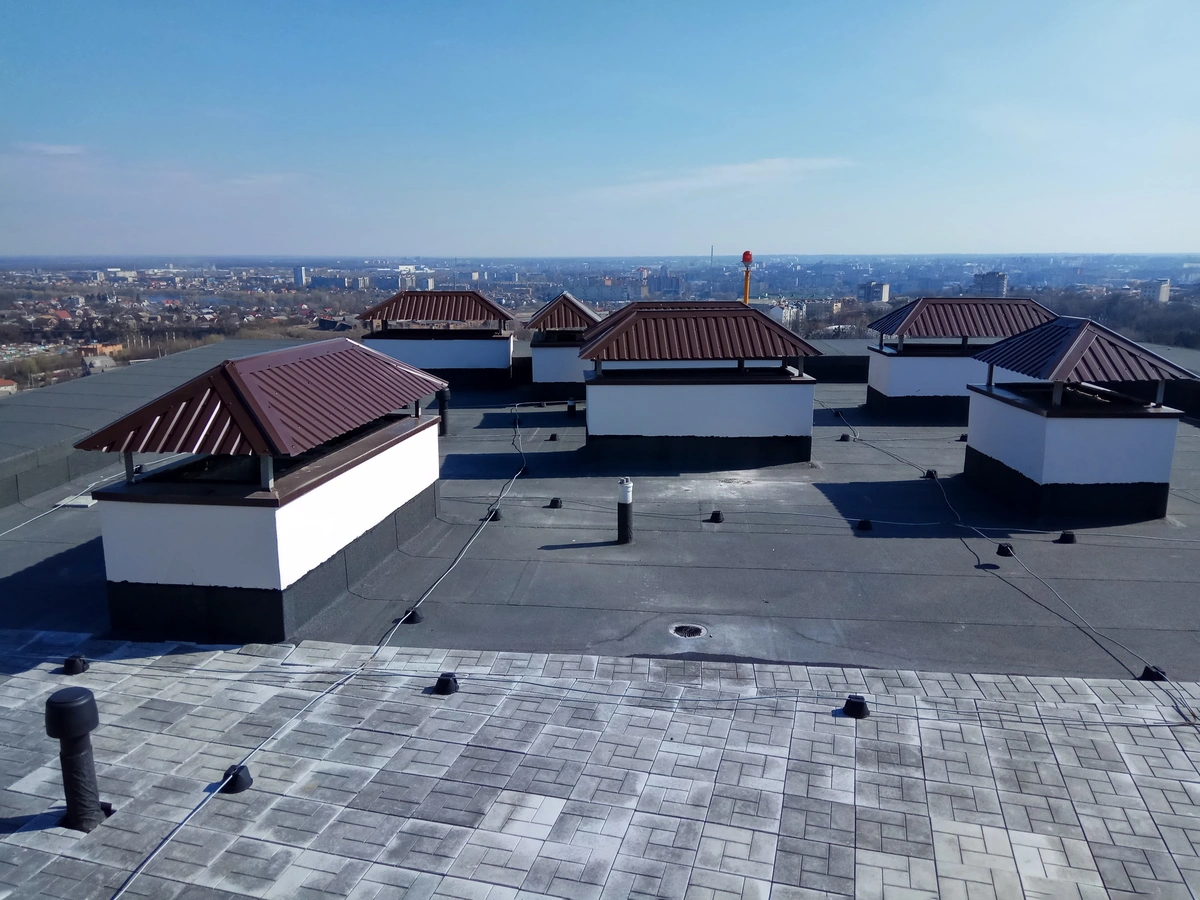
Office buildings in San Antonio's downtown core are a category of their own. Frost Tower at - where our office sits on the 15th floor - and Weston Centre two blocks north are the anchors of the financial district. Both are steel-frame high-rise buildings with low-slope roofs far above street level, concentrated rooftop mechanical equipment, and tenant operations that cannot tolerate crane staging or construction noise during business hours without advance coordination. The Tower of the Americas on Hemisfair Park is a different animal - a landmark structure where roofing work requires coordination with the City's historic and tourism considerations.
The Stone Oak and US-281 North corridor carries a different inventory: the Sonterra office parks, corporate campus buildings for USAA affiliates, and the HEB Technology Center on Rittiman Road. These buildings are typically 3 to 6 stories, 50,000 to 200,000 sq ft of flat roof per building, and most are 15 to 25 years old - which puts them squarely in the replace-or-recover decision window.
Our project managers know both inventories. The downtown towers require crane permitting coordination with the City of San Antonio and tenant communication that starts weeks before mobilization. The suburban campus buildings require production schedules that protect active parking and building entries. Neither is a job where you show up with a standard proposal and expect it to fit.
High-Rise vs. Mid-Rise - Different Scope Considerations
High-rise downtown office towers carry roofs level. Wind exposure at that height changes the fastener pattern calculation - IBC 2021 wind-uplift requirements for high-rise exposure on a San Antonio building push fastener density significantly beyond the standard warehouse specification. The roof access itself requires planning: material lifts on tower roofs often use the building's own mechanical room or dedicated hoist equipment, not a ground-based crane. We specify the hoist plan before the project starts.
Concentrated rooftop mechanical equipment is the other high-rise characteristic. A 20-story office tower Flashing around that equipment density is where leaks start on office tower roofs - not in the field membrane. We photograph and document every curb flashing, penetration sleeve, and equipment pad detail at scope and at closeout.
Mid-rise suburban office buildings on the Stone Oak and Loop 1604 corridors have different access challenges. Grade-level crane staging conflicts with tenant parking and building entries. On occupied buildings, we stagger crane windows, set staging on areas of the lot that do not affect the primary tenant entrance, and coordinate with property management before any crane move. Production on these buildings typically runs in 5,000 to 10,000 sq ft daily sections with same-day dry-in.
What Class A Office Tenants Require
Class A office buildings lease on schedules where tenant expectations are explicit. A roof project that generates construction noise during business hours, drops debris near the building entry, or forces parking lot closures without advance notice generates lease-compliance conversations that the building owner has to manage. We produce a written Tenant Impact Plan before mobilization on every occupied office building - noise windows, crane staging dates, parking impacts, and the emergency contact chain if something unexpected happens.
The roof membrane on a downtown Class A tower also affects the building's energy efficiency score, which matters for LEED-certified properties. White 60-mil or 80-mil TPO is the default recommendation for most San Antonio office buildings - the reflective surface reduces the HVAC load on the top floors, which is measurable in July and August when ambient temps exceed 100°F and rooftop surface temperatures can exceed 160°F on dark membranes. We document the membrane SRI (solar reflectance index) at closeout for LEED or ENERGY STAR documentation.
Warranty documentation matters more on Class A office assets than on industrial buildings. The property manager, the property owner, and the institutional lender all want a clean warranty record. We close out every office building project with the manufacturer NDL warranty document, the photo-keyed zone diagram, the maintenance contract that keeps the warranty active, and the written condition record.
Permit and Coordination Requirements
Downtown San Antonio roofing work requires City of San Antonio Development Services permits and, for crane use in public rights-of-way, a right-of-way encroachment permit coordinated with COSA Public Works. We manage both. For buildings near the Riverwalk or Alamo Plaza, we coordinate with the Riverwalk Authority and the City's Historic Preservation Office if the scope affects any visible exterior element.
The Stone Oak and Loop 1604 suburban office buildings fall under COSA jurisdiction for most work, though properties outside Loop 1604 may fall under unincorporated Bexar County jurisdiction. We verify jurisdiction and pull the correct permits before mobilization on every project.
For Weston Centre, Frost Tower, and other buildings in the central business district, the permit process involves pre-application meetings with Development Services for large replacement projects. We have run through that process multiple times and know the typical review timeline - usually 10 to 15 business days for straightforward commercial roofing permits, longer if structural details trigger additional review.
Frequently asked questions
How do you manage roofing work on a fully occupied downtown office tower?
With a written Tenant Impact Plan distributed before mobilization. That plan specifies the crane staging window and location, the noise-generating operations and their hours, the parking impacts and alternative parking directions, and the emergency contact for the building's property manager. On towers like those in the Frost Tower / Weston Centre cluster, we schedule crane lifts for early morning or weekend windows to avoid peak business hours. Construction noise from roofing equipment is documented against the City of San Antonio noise ordinance limits.
Does a roof replacement affect our LEED certification?
It can improve it. A white reflective TPO or EPDM membrane carries a higher SRI than an aged dark membrane, which contributes to the LEED Heat Island Reduction credit. We document the membrane SRI at closeout and can produce the LEED-ready documentation for your project manager. If your building is LEED-certified, let us know before scoping so we can specify to the credit requirements.
Can you work on the Tower of the Americas or other landmark buildings?
Yes, with the appropriate coordination. The Tower of the Americas is operated by the City of San Antonio through its Convention and Sports Facilities Department. Roofing work there requires coordination with the City's facility operations team and, depending on scope, the Office of Historic Preservation. We flag those coordination requirements before scope finalization so the timeline accounts for review periods.
Office building roofing scope in San Antonio?
Our project managers will walk the roof, document conditions, and produce a written scope with a Tenant Impact Plan tuned to your building's operations - not a generic proposal.
Request a Roof Scope