
 Clear scope. Clean execution.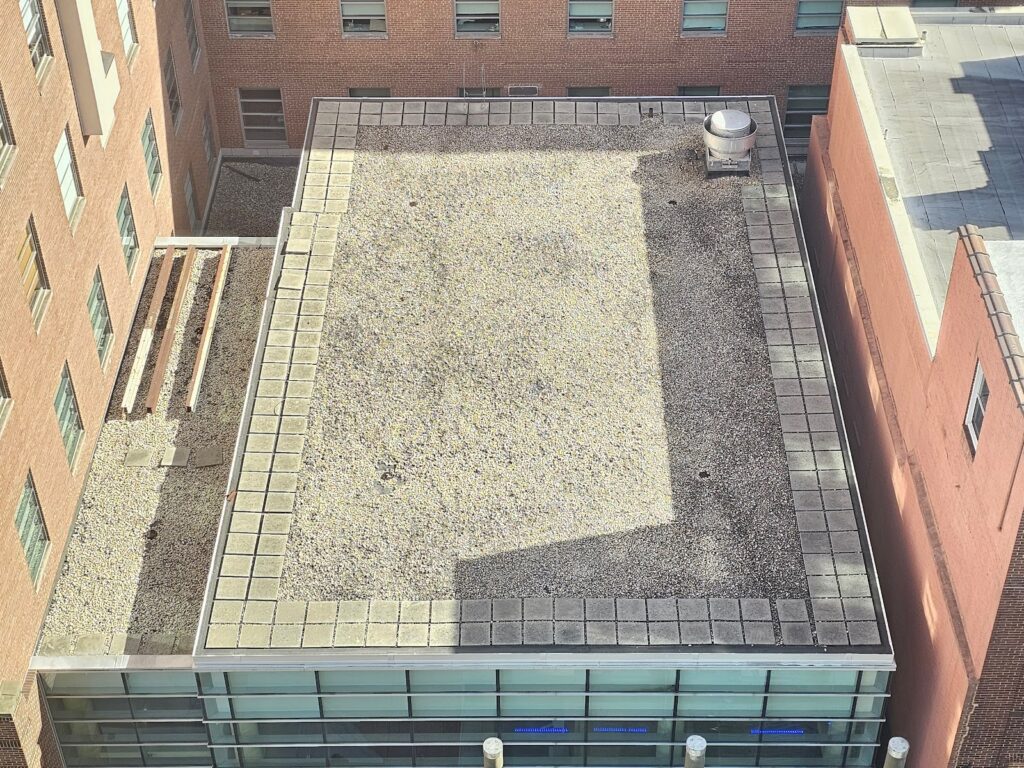
Ballasted roofing was a dominant installation method for single-ply commercial roofs through the 1980s and into the 1990s. The membrane is loose-laid over the insulation and held in place by 1.5-inch river-washed stone at 10 to 12 pounds per square foot - roughly 600 to 720 pounds of stone per roofing square. San Antonio's commercial inventory from that era carries a significant amount of ballasted EPDM and ballasted TPO. The South Side industrial corridor, the older strip centers along Culebra Road and Zarzamora Street, and the Loop 410 commercial ring from the pre-2000 buildout all have buildings running ballasted systems.
Commercial Roofers of San Antonio replaces and maintains existing ballasted systems. We do not, however, routinely specify stone ballast on new commercial construction in San Antonio, and we explain that position directly to building owners who ask about it. The dead-load requirement, the drain accessibility limitations, and the energy code challenges that stone ballast creates in the current construction environment make it the wrong specification for new San Antonio commercial work in almost every case. For the buildings that already have ballasted systems, the question is whether to repair, recover, or replace - and that answer depends on what the moisture survey and deck inspection show.
Why We Rarely Specify Stone Ballast on New San Antonio Construction
Dead load: Ten to twelve pounds per square foot of ballast stone adds 500 to 600 pounds per roofing square to the structural load above the deck. Modern metal deck and structural framing systems are designed for specific dead and live loads, and ballast stone often exceeds the available dead-load capacity on buildings framed for conventional roofing assemblies. Specifying ballasted roofing on a building that cannot structurally support the load is a liability issue, not just a design preference.
Energy code compliance: IECC 2021 requires cool-roof reflectance and emittance values for low-slope commercial roofs in San Antonio. Stone ballast covers the membrane surface, blocking most of the reflective benefit of a white membrane. A ballasted system typically fails to A code-compliant ballasted assembly requires specific thermal mass calculations that are complicated and often do not produce a clear compliance path without a special energy analysis.
Drain and maintenance access: Stone ballast must be cleared from drain basins regularly to maintain flow capacity - a maintenance task that building owners routinely neglect. The ballast also makes future inspection, leak investigation, and recover work significantly more difficult and expensive. Pulling ballast, conducting the inspection or repair, and replacing the ballast adds substantial labor cost to every maintenance event over the life of the system.
Wind uplift: Ballasted systems resist wind uplift through the weight of the stone, not through mechanical fasteners. This works in low-exposure inland locations but requires careful analysis at buildings with elevated wind exposure - corner zones on taller buildings, open-terrain sites near the Loop 1604 fringe development, or buildings adjacent to large open areas. If the ballast calculation does not produce adequate uplift resistance without supplemental fastening, the system requires a hybrid approach that undermines the cost advantage of the ballasted method.
Existing Ballasted Systems - Inspection and Replacement Planning
Inspecting a ballasted roof requires clearing ballast from representative inspection points before the membrane can be evaluated. We clear stone at drain basins, at visible low points, at penetrations, and at randomly selected field points. The membrane under ballast is protected from UV degradation by the stone, which means ballasted membranes often have better surface condition than exposed membranes of the same age - but the membrane is also completely inaccessible for visual inspection without moving stone, so problems that develop under the ballast are not identified until significant damage has occurred.
Moisture survey on ballasted systems uses nuclear gauge or infrared scanning to identify wet insulation zones without pulling all the stone. We use capacitance moisture meters at cleared inspection points to confirm scanner results. On ballasted roofs older than 20 years, we typically find more insulation saturation than the roof's visible condition suggests - because water infiltrates at seam failures or drain-ring failures and migrates under the ballast without any visible surface indication.
Replacement options: When a ballasted system needs replacement, we almost always remove the ballast and replace with a mechanically attached single-ply system. The new system is lighter, energy-code-compliant, and maintains its accessibility for future inspection and maintenance. We dispose of the ballast stone or, when the stone is clean and uncontaminated, arrange for recycling. The cost of ballast disposal is included in the tear-off scope before the owner commits to the project.
When Ballast Replacement Is the Right Move
Recover-in-place with membrane replacement is occasionally the right move on a ballasted system where the deck is sound, the insulation is dry in the surveyable zone, and the building owner cannot absorb the dead-load reduction that removing the ballast and installing a mechanically-attached system would provide on a structurally borderline deck. In this scenario, the old membrane is removed, the insulation inspected and patched where needed, new EPDM is installed loose-laid, and the original ballast is replaced after inspection. We have done this on a handful of buildings in San Antonio where the structural load situation made it the right answer.
Ballast redistribution is sometimes necessary after a wind event that has displaced stone into drain basins or off the roof edge. We respond to ballast-displacement emergency calls for buildings on our maintenance contracts - this is a safety issue when displaced stone lands in pedestrian or vehicle areas below the roof edge.
If you have a San Antonio commercial building with a ballasted roof and you are not sure what the condition of the membrane is underneath the stone - and most ballasted-roof building owners do not know - the right first step is a moisture survey and core inspection. The information that comes back from that inspection drives every subsequent capital decision about the system.
Frequently asked questions
Can I add ballast to an existing mechanically-attached roof for additional wind uplift resistance?
In most cases, no. Adding stone ballast to an existing mechanically-attached system requires a structural analysis confirming the deck can support the additional dead load, and it converts the system to a partially-ballasted hybrid that complicates the wind-uplift analysis and the warranty status. If you have a wind-uplift concern on an existing mechanically-attached system, the right solution is supplemental fastening - not ballast addition.
How do I know if my San Antonio building's ballasted roof needs replacement?
The indicators are: drain basins clogged with ballast and debris leading to standing water, visible membrane edge delamination at parapet flashings or drain rings, active leaks without an obvious surface source (suggesting membrane failure under the ballast), or a building age that puts the system in the 25-to-35-year range where replacement planning is prudent regardless of visible surface condition. A moisture survey is the definitive answer.
Does San Antonio allow stone-ballasted roofing on new construction?
The City of San Antonio Building Code does not prohibit ballasted roofing, but IECC 2021 energy code compliance for the cool-roof requirement is difficult to achieve with a standard stone-ballasted system. The structural load analysis is also a requirement for any system that exceeds the design-basis dead load. In practice, the code compliance and structural constraints effectively eliminate stone ballast as a practical option for most new commercial construction in the current regulatory environment.
Ballasted roof on a San Antonio building that needs evaluation?
Our project managers will conduct a moisture survey, clear representative inspection points, and produce a written assessment of the membrane condition, insulation status, and replacement options.
Request a Roof Scope