
 Clear scope. Clean execution.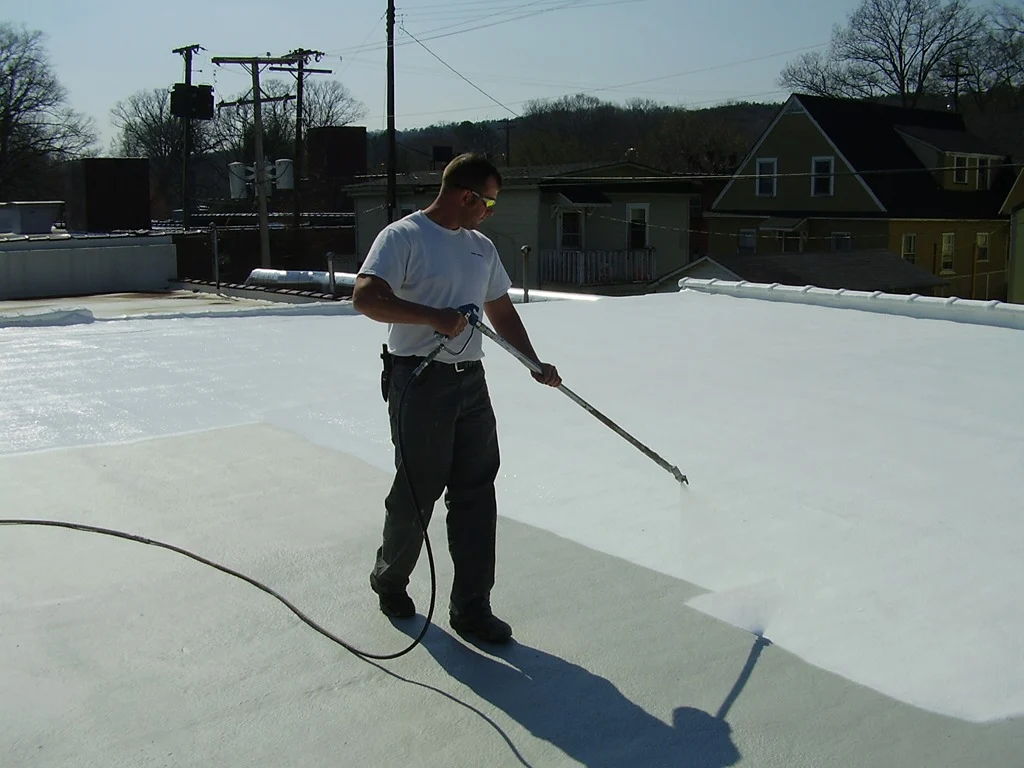
Spray polyurethane foam roofing is not the right system for every commercial building in San Antonio, and we say so when the building is not a good candidate. But for the right building - an industrial facility with complex rooftop geometry and dozens of penetrations, a cold-storage warehouse where the thermal performance of the roofing assembly directly affects refrigeration operating cost, or a building with a substrate that makes membrane attachment difficult - SPF solves multiple problems with a single application.
SPF sprays as a two-component liquid that reacts, expands, and cures to a rigid closed-cell foam in seconds. The cured foam is self-leveling around penetrations, equipment curbs, and irregular substrates. It creates its own air barrier, provides R-6 to R-7 per inch of insulation, and is inherently waterproof when protected by an appropriate UV-protective topcoat. Commercial Roofers of San Antonio installs SPF systems on San Antonio industrial buildings where the system's advantages justify the higher installation cost and the specialized application requirements.
Closed-Cell SPF Density and Why It Matters
Commercial roofing SPF is specified at 2.5 to 3.0 lb per cubic foot closed-cell density. This is not the same as the open-cell spray foam used for interior insulation - open-cell foam is soft, absorbs moisture, and is not a roofing material. Closed-cell SPF at 2.5 to 3.0 lb density is rigid, moisture-resistant, and load-bearing enough to support rooftop traffic for maintenance activities.
The insulation value of closed-cell SPF at 2.5 lb density is approximately R-6.5 per inch. A 2-inch SPF application delivers R-13; a 3-inch application delivers R-19.5; a 4-inch application delivers R-26. Current Texas IECC minimum for low-slope commercial roofs in Climate Zone 2 is R-25 - achievable with 4 inches of SPF in a single application without the separate insulation layer, cover board, and membrane attachment layers that a conventional single-ply assembly requires. On buildings with limited height at the roof edge or parapet, the thinner profile of an all-SPF assembly is a structural advantage.
Density verification: SPF density is verified by laboratory analysis of foam samples pulled during application - not by visual inspection. We pull foam samples on every SPF project and submit them for density verification. The results are included in the project closeout documentation. If density falls below the specified minimum, the off-spec material is ground off and re-sprayed before the topcoat application.
UV Protective Topcoat - Why SPF Cannot Stand Alone
Uncoated SPF exposed to UV radiation degrades rapidly. In San Antonio's solar environment, unprotected foam begins showing friability - surface chalking and granular breakdown - within months. The foam itself is not UV-stable and must be protected by a spray-applied elastomeric topcoat within hours of the foam application, before the foam surface has time to oxidize.
Silicone is the preferred topcoat in San Antonio for the same reasons it is the preferred field coating on conventional membranes: UV resistance, ponding-water resistance, and coating-over-coating re-coat compatibility. The silicone topcoat is applied at 20 to 30 dry mils over the cured foam surface and is granule-embedded in traffic areas for skid resistance. Acrylic topcoats are used on some SPF systems but degrade faster under San Antonio's UV load - we specify silicone on all San Antonio SPF projects.
The topcoat warranty is separate from the foam warranty on most SPF systems. SPF manufacturers typically warrant the foam for 10 to 20 years; the coating manufacturer warrants the topcoat separately. The system warranty requires that both the foam and the topcoat be maintained - the topcoat requires periodic inspection and re-application at the end of its service life to keep the foam protected and the system warranty active.
San Antonio Industrial Applications for SPF
Cold-storage and refrigerated distribution facilities along the IH-35 South and IH-10 West corridors are strong SPF candidates. The thermal performance of the roofing assembly directly affects refrigeration energy consumption, and SPF's high R-value per inch minimizes the assembly thickness required to achieve the insulation depth that refrigeration systems need. The air barrier function of closed-cell SPF also eliminates the convective heat transfer that occurs in conventional mechanically-attached single-ply assemblies with permeable insulation.
Metal building roofs on industrial facilities in the San Antonio metro are SPF candidates when the existing metal panel system has reached the end of its service life. Spraying SPF over existing metal panels avoids the tear-off cost and provides the thermal and air-barrier upgrade in a single application. The foam bridges the metal panel seams and creates a continuous substrate for the topcoat.
Rooftop equipment clusters with complex penetration geometry - older manufacturing facilities in the IH-35 South industrial zone with legacy equipment that has been added, relocated, and modified over decades - are buildings where SPF's self-forming geometry around penetrations eliminates the labor-intensive flashing fabrication that a conventional membrane system requires. The foam self-seals around irregular penetrations in a way that no sheet membrane can.
Frequently asked questions
Can SPF be installed on any commercial roof in San Antonio?
SPF requires a clean, dry substrate - the foam cannot bond to wet, oily, or heavily contaminated surfaces. It also requires controlled ambient conditions during application: wind below 15 mph (off-gassing foam in high wind creates overspray and application quality problems), temperature above 50°F and below 100°F, and low relative humidity. San Antonio's summer afternoons routinely push above the upper temperature and wind limits, which is why SPF application in San Antonio is typically a morning-production system - earlier than even the heat-limited single-ply schedule.
How often does the silicone topcoat on SPF need to be re-applied?
The silicone topcoat at 20 to 30 dry mils has a service life of 10 to 15 years in San Antonio's UV environment. At the end of that period, the topcoat requires inspection - if it is thinning but intact, a recoat application restores UV protection and extends the system. If the foam is showing surface degradation, the degraded foam is ground off and new foam and topcoat are applied in those areas. The re-coat cycle is the maintenance commitment that SPF building owners accept in exchange for the system's insulation and waterproofing performance.
Is SPF roofing more expensive than conventional single-ply?
Installed SPF typically costs more per square foot than mechanically-attached TPO on a straightforward metal-deck building. The premium is justified when the building's insulation requirements, complex geometry, air-barrier requirements, or existing substrate conditions make conventional single-ply installation significantly more expensive or less effective. We scope both options for SPF candidates so the building owner can see the lifecycle cost comparison, not just the initial installed cost.
Industrial building in San Antonio that might be an SPF candidate?
Our project managers will assess the substrate, evaluate the insulation and air-barrier requirements, and produce a comparison scope showing SPF and conventional single-ply options with lifecycle cost estimates.
Request a Roof Scope